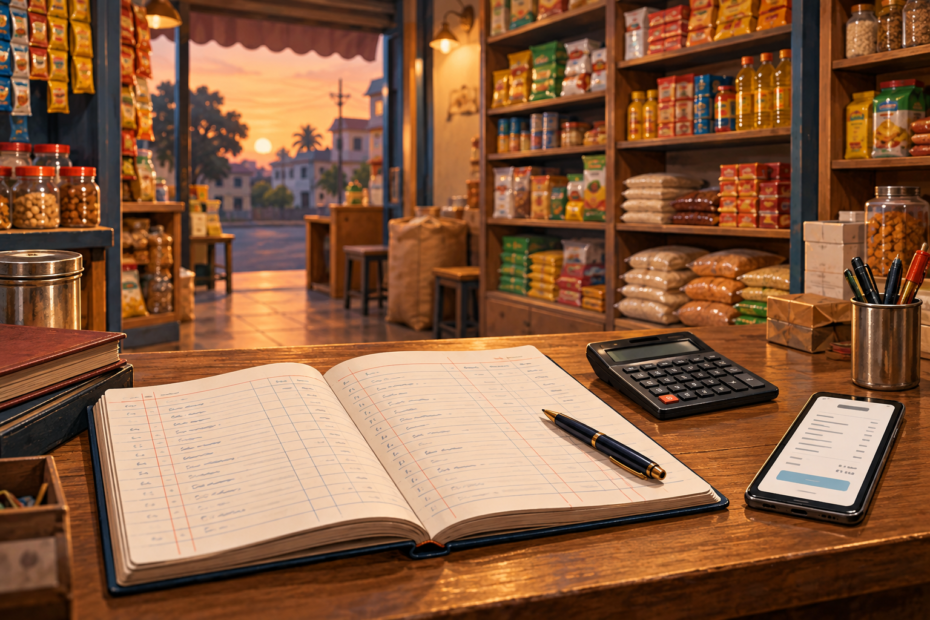
A busy counter does not tell you how much money your shop made. A daily sales register helps you separate sales, payments received, credit sales and expenses. Start with a notebook or spreadsheet; the important part is recording the same information every day.
What to record for each sale
Use these columns: date, bill number, item or order reference, total sale, cash received, UPI received, card received, credit given and notes. A sale should appear once, even when the customer pays partly in cash and partly through UPI.
A worked example
Suppose your shop sells ₹8,000 of goods today. Customers pay ₹3,000 in cash and ₹4,000 through UPI; ₹1,000 is sold on credit. Record ₹8,000 as sales, ₹7,000 as money collected against today’s sales and ₹1,000 as new customer dues. These are three different figures.
If another customer pays ₹500 owed from last week, record that as recovery of an old balance. It increases money received today but does not create another sale. Otherwise you count the same purchase twice.
Sample daily sales register
| Bill | Sale | Cash | UPI | Credit |
|---|---|---|---|---|
| 001 | 3,000 | 3,000 | 0 | 0 |
| 002 | 4,000 | 0 | 4,000 | 0 |
| 003 | 1,000 | 0 | 0 | 1,000 |
| Total | 8,000 | 3,000 | 4,000 | 1,000 |
Check your cash drawer
Expected closing cash = opening cash + cash received − cash paid out. For example, ₹1,000 opening cash + ₹3,000 cash sales + ₹500 old dues collected in cash − ₹400 paid for delivery = ₹4,100. Count the actual drawer and write down any difference. UPI receipts do not belong in this cash calculation.
Reconcile digital payments
Match each digital receipt against your merchant app or bank record. Check the amount, status and transaction reference. A customer’s screenshot alone is not confirmation that money reached you. Keep pending or failed payments separate until you can verify them.
For card or payment-gateway collections, record gross sales separately from settlement amounts. Fees, refunds and settlement timing can explain a difference. Match each settlement to its statement rather than treating every bank credit as a new sale.
Sales are not profit
₹8,000 of sales does not mean ₹8,000 earned. Deduct the cost of the goods sold, transaction costs and other expenses to estimate profit. Buying stock today and selling stock today are also different events: some purchases remain on your shelf. Use our product pricing guide to check whether each order leaves enough margin.
A ten-minute closing routine
First total your bills. Next separate cash, digital collections and credit sales. Record refunds and old dues collected. Count cash, check digital receipts and note unexplained differences. Finally list unpaid customer balances and back up the register somewhere you can recover it.
Keep access limited to the people who need the records. An order number is usually enough in a shared summary; avoid copying customers’ full phone numbers and addresses into every report. For chat-based orders, use WhatsApp Business labels alongside your register.
This is an operational example, not a statutory accounting format. GST invoices, returns and other required records depend on your business. Ask your accountant how this daily summary should connect to your formal books.
Pingback: How to Price Products for Online Selling (With Formula)